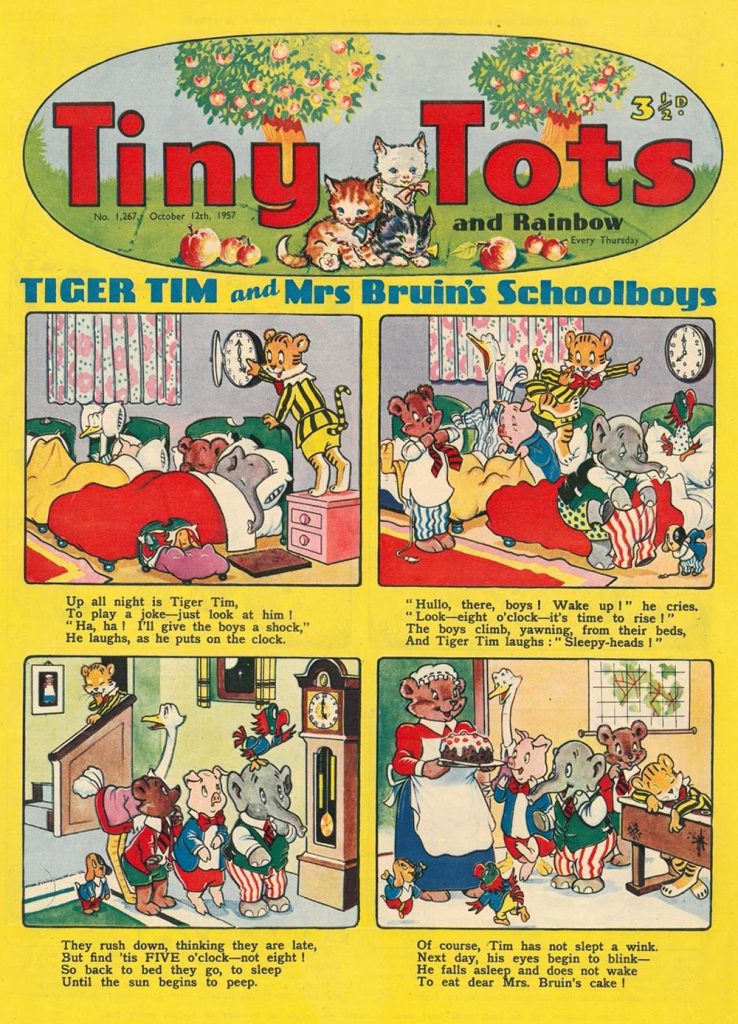
Julius B. Stafford Baker was born in Leigh-on-Sea, Essex. The family was artistic, his father, also Julius, was the creator of the Tiger Tim comic strip in the children’s comic The Rainbow. Julius senior had apprenticed under his uncle John Philip Stafford (1851–1899), an artist who also worked as a cartoonist for the magazine Funny Folks.
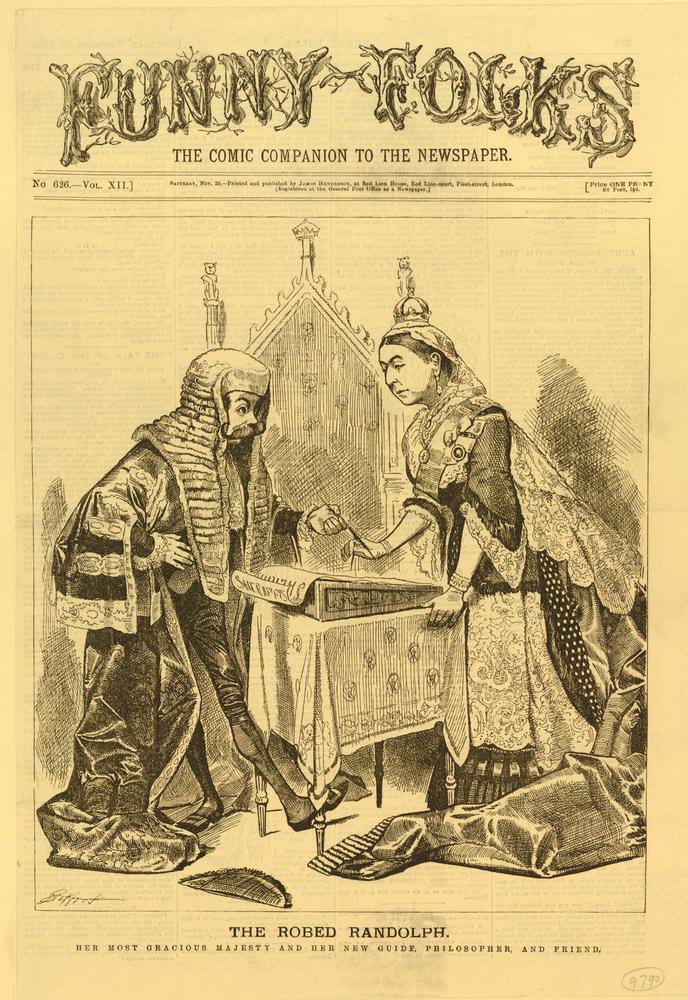
Julius took over his father’s illustration work on Tiger Tim while teaching himself how to paint. He painted many different scenes, working sometimes in watercolour and oil.
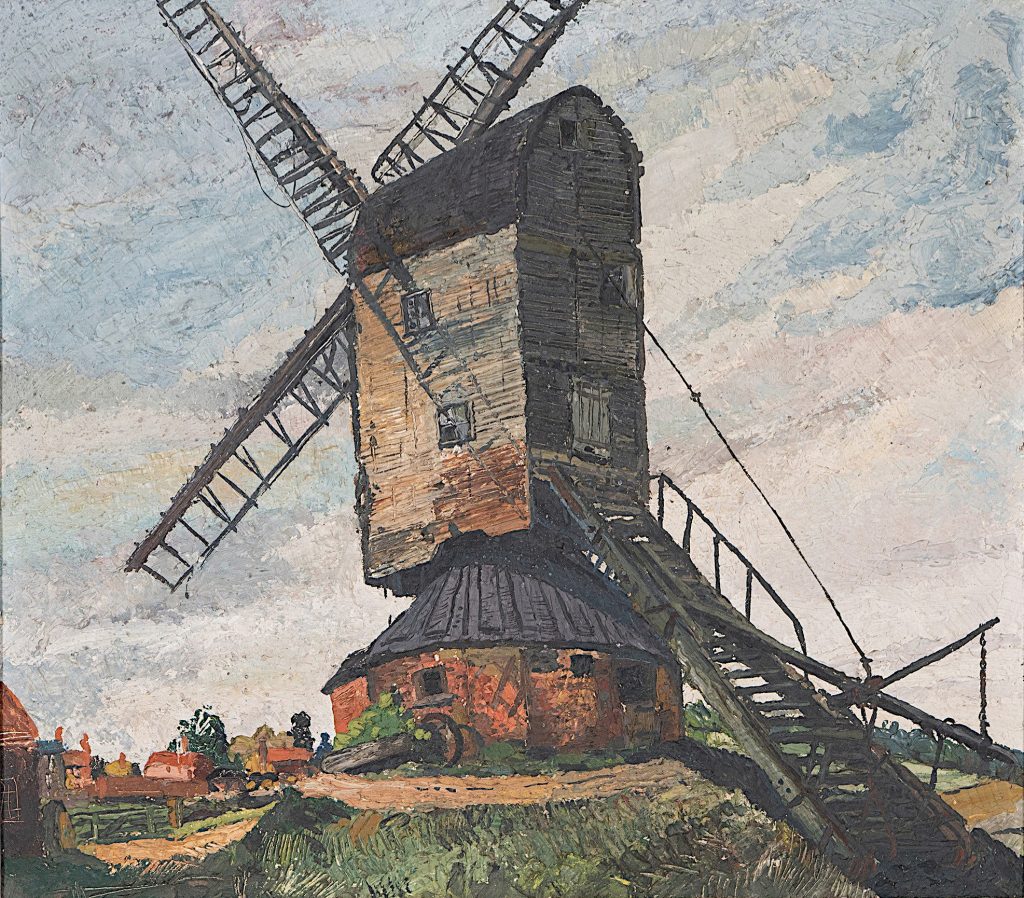
The painting of the windmill below from the 1930s, is one of a series of windmills he painted. It has all the feeling of the Recording Britain scheme that would happen later.
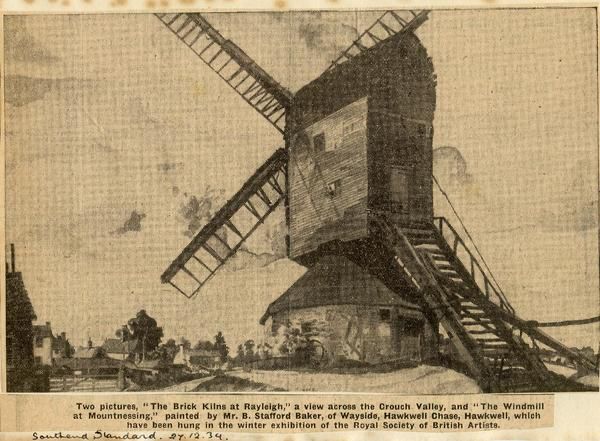
There is an interesting piece from a magazine showing a watercolour of the same scene from the Winter exhibition of Royal Society of British Artists.
He had a lifelong fascination with the Royal Air Force, which began as a messenger boy for the Royal Flying Corps in 1918, and during World War II he was in the Air Force attached to a radar unit, then became an intelligence officer, serving abroad. He would then spend his spare time painting the conditions.
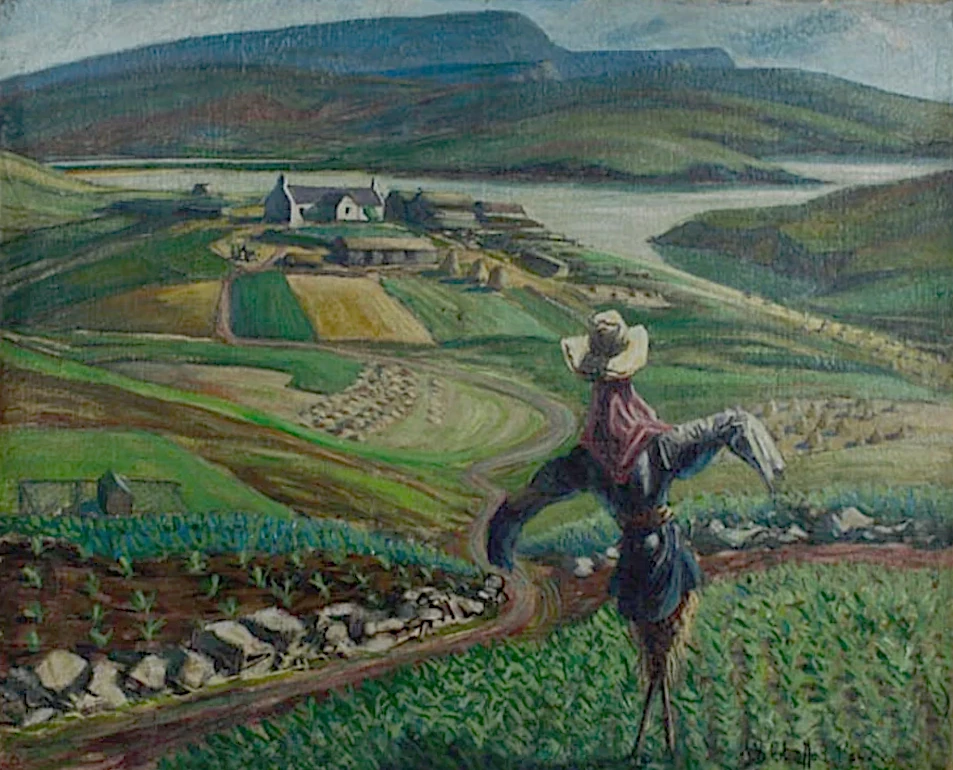
The War Artists’ Advisory Committee bought hundreds of pictures of planes from him, which found their way into numerous public collections, including Imperial War Museum, British Museum and Victoria & Albert Museum as well as his watercolours of atrocities of war wherever he travelled to. After the war continued as a children’s illustrator and showed at RA, in 1956 winning a Giles Bequest Prize at Victoria & Albert Museum for printmaking.
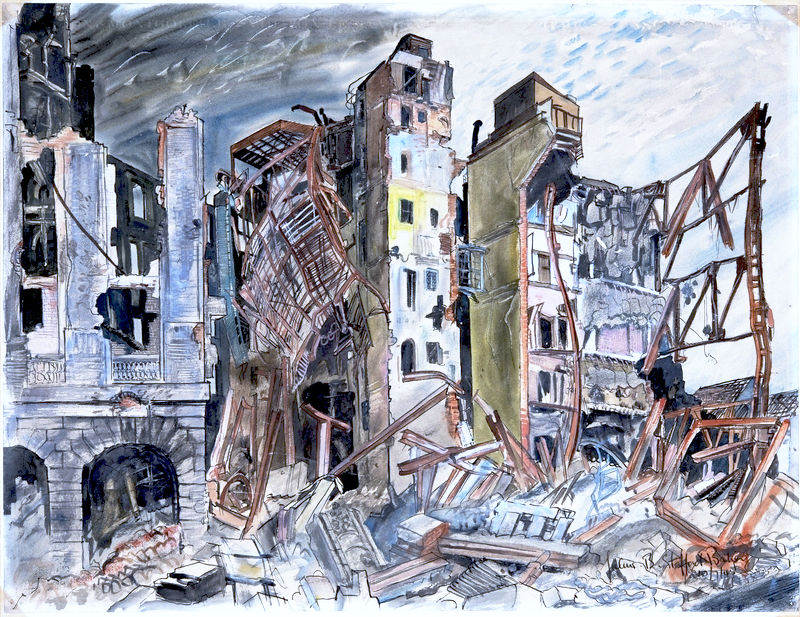
After serving with a radar unit during the Battle of Britain, he became an intelligence officer, and his artistic skills and his aeronautical knowledge made him a useful commodity, but he was never made an official war artist, primarily because the role was forbidden to those in the field of intelligence. In 1943 he was sent as courier on a flight behind enemy lines to Yugoslavia to deliver the letter from Churchill promising support to General Tito.
The most prolific painter of bombed Germany was Flight-Lieutenant Julius Stafford-Baker, who toured the country in the spring of 1945 as a RAF intelligence officer. George Orwell also visited Germany in this period as a war correspondent for the Observer. He told readers that the damage was on a totally different scale to Britain’s blitzed cities: “To walk through the ruined cities of Germany is to feel an actual doubt about the continuity of civilisation. The paintings the WAAC purchased from Stafford-Baker communicated little of the apocalyptic scale of devastation that he must have witnessed. Instead, his paintings acted to recast the nature of Bomber Command’s actions by emphasizing precision bombing and ignoring the mainstay of their operations, area bombardment.
Rebecca Searle – Art, Propaganda and Aerial Warfare in Britain During the Second World War, 2022
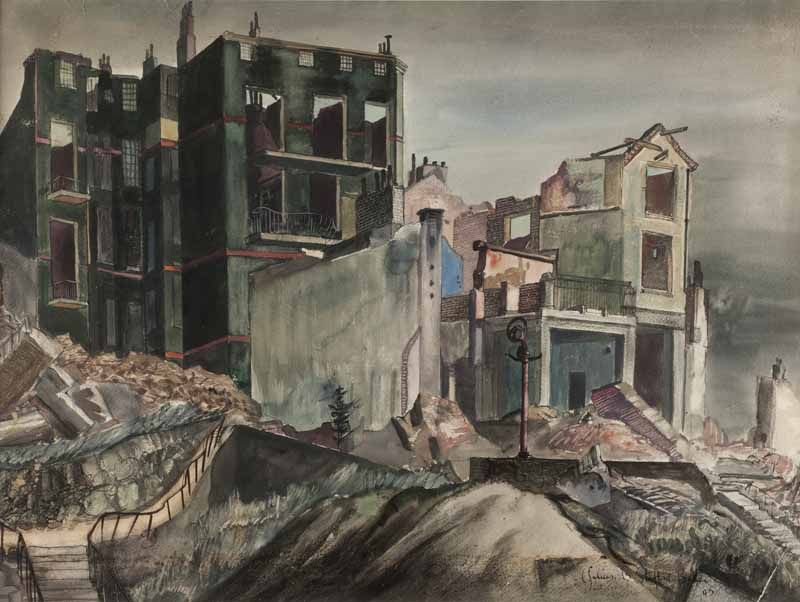
Stafford-Baker focused on damage to industrial, governmental or military targets. The titles of the paintings made clear that the ruins depicted were legitimate targets: A Pumping Station on the River Lippe; The Krupp Works at Essen; The Railway Station at Hanover; The Rhine Bridges at Wesel; A V2 Train in a Railway Cutting at Oyle; The Aircraft Works under the Templehof Air Port; The Headquarters of the SS: The Gestapo and the Security Police; The Headquarters of Goebbel’s Ministry of Propaganda; Direct Hits by RAF Bombs on the German Air Ministry; and The Chancellery: Hitler’s Headquarters in Berlin. Words in the titles such as ‘pin-point bombing’ and ‘direct hits’ suggested that these targets had been hit accurately and precisely and were not, as was usually the case, the result of blanket bombing across the area in which they were situated. Contrast can be drawn between these images of the British bombing of Germany, and those that Stafford-Barker painted of the German destruction of the continent, which were also purchased by the WAAC. In Holland, for example, he recorded the destruction of The Ancient Salt Gate and a bombed school, while his painting Ruined Warsaw depicted the whole city seemingly reduced to rubble. Through the language of ruins, these images reinforced the propagandist differentiation between the barbarous actions of the Nazis and the more legitimate nature of Britain’s use of air power.
Rebecca Searle – Art, Propaganda and Aerial Warfare in Britain During the Second World War, 2022
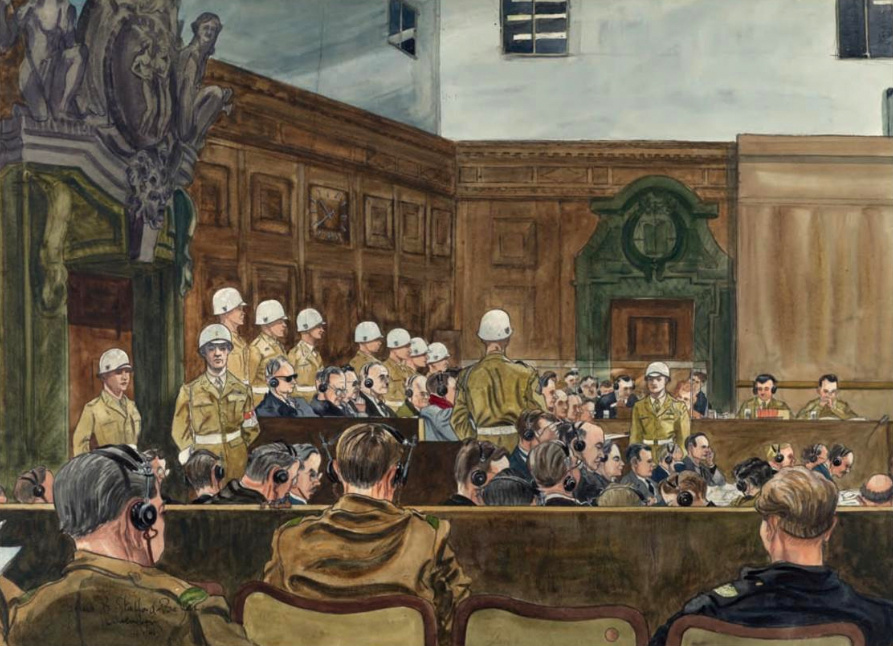
The WAAC acquired just a few images which depicted more general scenes of devastation. Anthony Gross and William Warden painted images of Cologne. Although both conveyed the extent of devastation, they each focused on the virtually intact cathedral. While Coventry Cathedral became a symbol of Britain’s suffering and endurance in the face of ruthless German bombing, during the war newspapers described Cologne Cathedral as deliberately spared to suggest that the Allies were more respectful in their bombing (whereas in fact it was likely spared as a navigational landmark).
Rebecca Searle – Art, Propaganda and Aerial Warfare in Britain During the Second World War, 2022
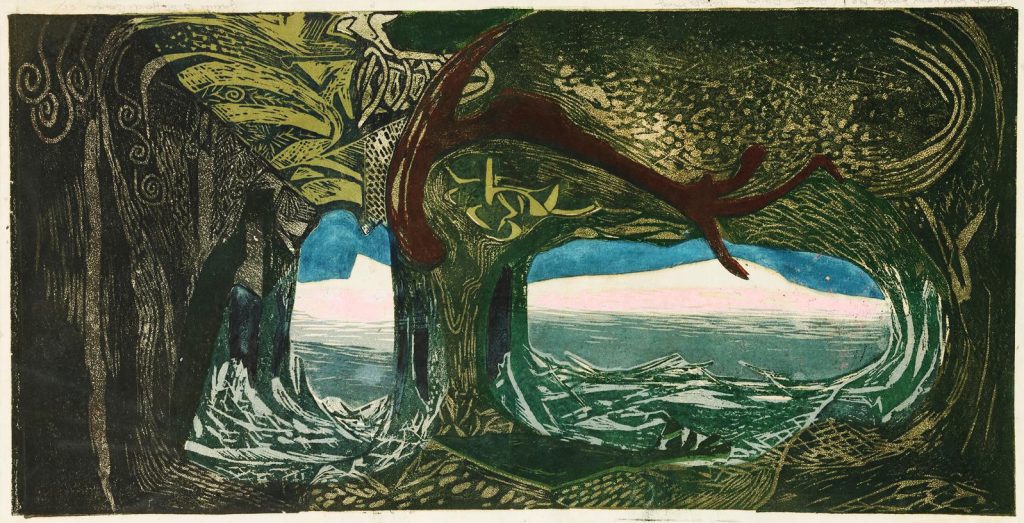
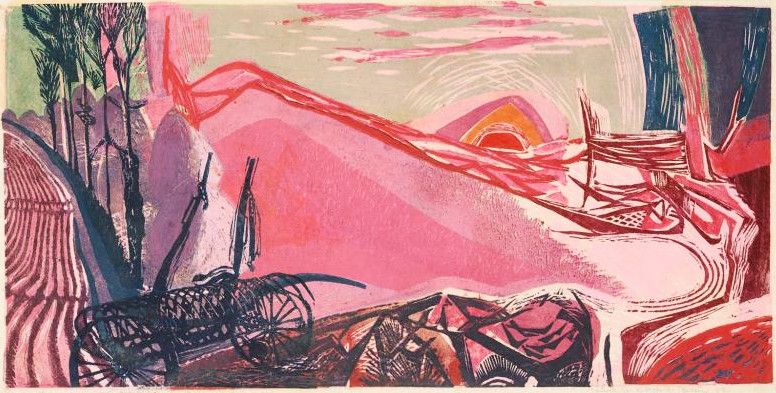
After the war he moved to 8 Stambourne Rd, Toppesfield, Essex and started to work in printmaking, with an extraordinary set of neoromantic works, inspired by the spirit of the age and likely Michael Rothenstein, though he might have trained under Michael.
As part of the International Giles Bequest Competition for printmakers at the V&A in 1956 the works won were:
1st Prize – Michael Rothenstein ‘Cockerel’
2nd Prize – Edward Bawden ‘Brighton Pier’
3rd Prize – Julius Stafford-Baker – ‘The Underground’
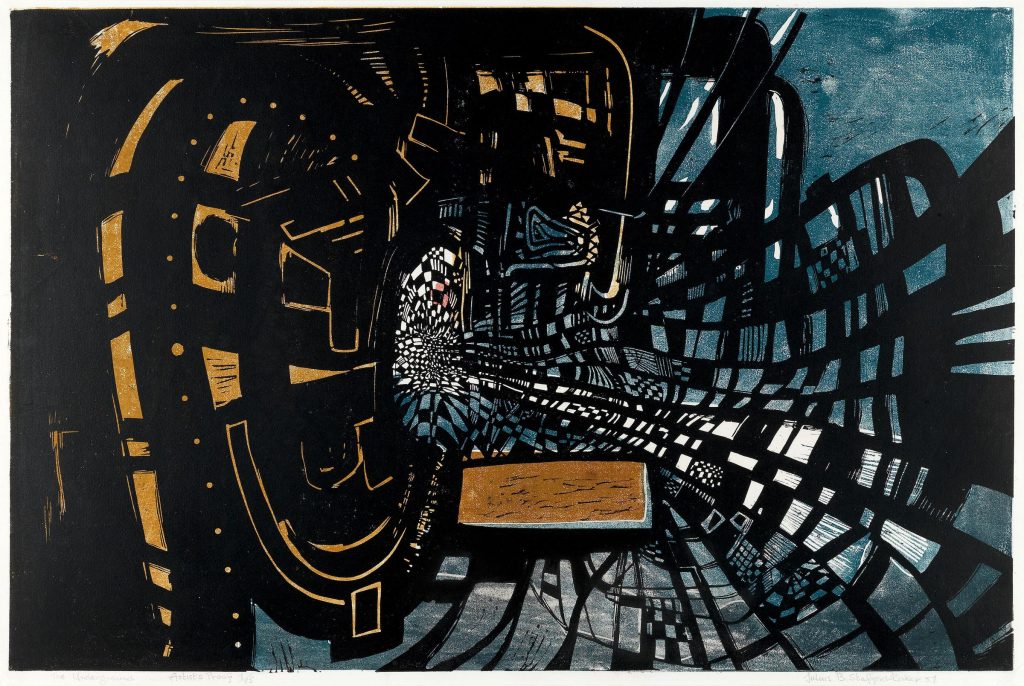
Julius Stafford-Baker for his linocut Underground , an unusual and yet evocative work in its shifting mosaic of blacks and blues.
The Studio, 1957